Jim Shao
In Newtonian mechanics, the gravitational force \(\vec{F}\) exerted on a particle of gravitational mass \(m\) by gravitational mass \(M\) is:
$$\vec{F} = -\dfrac{GMm}{r^3}\,\vec{r} \tag{1}$$Where \(G\) is the gravitational constant, \(r\) is the distance between the two particles, and \(\vec{r}\) is the direction vector from \(M\) to \(m\).
The potential energy \(U\) of particle \(m\) in the gravitational field of \(M\) is:
$$ U(r)=-\dfrac{GMm}{r} \tag{2}$$In general relativity, in the Schwarzshild spherically symmetric center gravitational field \(M\), the potential energy of particle \(m\) has an additional term compared to equation (2), because the metric of space-time is no longer flat,
$$ U(r)=-\dfrac{GMm}{r} - \dfrac{GML^2}{mc^2r^3} \tag{3}$$Where \(L\) is the angular momentum, \(L=rmv_\perp\), \(v_\perp\) is the velocity component of particle \(m\) perpendicular to the direction vector \(\vec{r}\), and \(c\) is the speed of light.
Therefore, the gravitational force exerted on \(m\) by \(M\) can be calculated as:
$$\begin{aligned} \vec{F} &= -\dfrac{\partial U(r)}{\partial r}\,\hat{r}_0 \\ &= -\dfrac{GMm}{r^3}\,\vec{r} \;-\; \dfrac{3v_\perp^2GMm}{c^2r^3}\,\vec{r} \end{aligned} \tag{4}$$According to Newton's second law, the equation of motion for a particle with inertial mass \(m\) is:
$$\vec{F} = m\vec{a} = m\,\dfrac{d^2\vec{r}}{dt^2} \tag{5}$$Let (5) = (4), if we consider that the gravitational mass of particle \(m\) is the same as its inertial mass, after eliminating \(m\) from both sides, we can obtain its second-order differential equation of motion:
$$\dfrac{d^2\vec{r}}{dt^2} = -\left(1 + \dfrac{3v_\perp^2}{c^2}\right)\dfrac{GM}{r^3}\,\vec{r} \tag{6}$$In a two-dimensional rectangular coordinate system, according to equation (6), we may write down the equations of motion in \(x\)- and \(y\)-direction for particles \(M\) and \(m\) respectively.
After non-dimensionalization and order-reduction, yield eight first-order equations. Then, using the Runge-Kutta numerical method, the instantaneous coordinates and velocity of each particle are calculated, and their trajectories are plotted.
Discussion 1
In 1859, French astronomer Leverrier discovered that even considering the perturbations of the other seven planets, and even including the effect of the Solar oblateness, the observed precession of Mercury's orbit around the Sun was still 43 arcseconds per century more than expected.
In 1915, Einstein published his theory of general relativity. After revising Newton's equations for calculating gravitational motion, he could accurately calculate this missing 43 arcseconds.
For over a century, the explanations of general relativity and the analytical solutions to its field equations have largely consisted of theoretical and mathematical derivations. Many readers, faced with complex formulas and strange symbols, struggle to understand them, often becoming intimidated and frustrated, then attributing simply to "space-time curvature" without further understanding.
However, precession is ultimately a problem of classical mechanics. This paper attempts to qualitatively, intuitively, and vividly explain some concepts of general relativity through force analysis and numerical solutions.
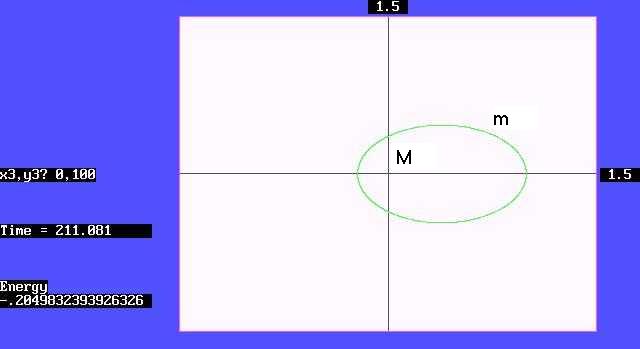
Figure 1 shows that if the Sun \(M\) had only one planet \(m\), according to Newtonian mechanics, \(m\) would orbit the Sun stably in an elliptical orbit without precession.
Figure 1.
However, according to general relativity, the force on a particle moving in a gravitational field has one more term than in Newtonian equation (1), as shown in the equation (4).
Our numerical calculations show that it is this tiny force, proportional to \(\dfrac{v_\perp^2}{c^2}\), that causes the precession of the planet's orbit around the Sun, as shown in Figure 2.
Figure 2.
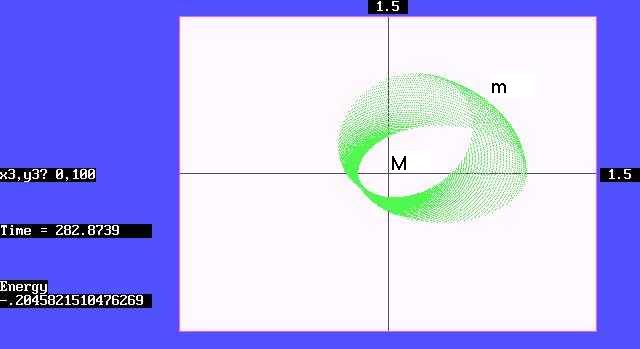
In the case of Mercury, due to its proximity to the Sun and the high eccentricity of its elliptical orbit, its perihelion radius \(r\) becomes very small, and \(v_\perp\) is at its maximum. Therefore, near the immense mass of the Sun, this tiny precession, originating from general relativistic effects, becomes directly observable.
Discussion 2
With the concept of "force" and through simulations and comparisons, this long-unexplained "redundant" precession seems easier to understand.
However, attentive readers may not be satisfied and will ask, "Where does this 'force' come from?"
Indeed, this extra gravitational term is quite strange; it is related to \(v_\perp\). If the particle \(m\) is stationary in the field \(M\), or only moves along \(\vec{r}\) direction, this force does not exist. Why is this?
To understand this, we must return to the concept of "space-time curvature."
Imagine a train traveling along a curve. Due to inertia, the wheels press against the outer rails, while the outer rails, fixed to the ground, exert back a constraint force on the wheels. It is this constraint that allows the train to move along the curve.
Similarly, when a particle moves in a strong gravitational field, if space-time is flat, according to Newtonian mechanics, the gravitational force acting on the particle perfectly balances the centrifugal force caused by its inertia, allowing it to move precisely along a quadratic curve within the gravitational field.
However, according to general relativity, space-time is a property of matter, and a gravitational field is a form of matter with curved space-time. The non-radial motion of a particle within it "compresses" the surrounding space-time ─the "railway"—and space-time itself responds with the same "force," constraining the particle's motion. This "constraint" from the gravitational field's space-time manifests as the precession of the elliptical orbit itself.
In short, finding the "force" from the "curvature of space-time" might be the key to understanding general relativity.
Written on March 22, 2026.
Discussion 3
As mentioned earlier, the observed precession of Mercury's orbit around the Sun (574.10 ± 0.65) is about 8%, or 42.44 radian-seconds per century, more than the predicted value (531.66 ± 0.69) by classical theory.
This problem puzzled astronomers for more than half a century, and they made various attempts to explain it, all unsuccessfully. It wasn't until 1915, when Einstein published his theory of general relativity, that he precisely calculated this "missing" 8% precession—42.98 ± 0.04 radian-seconds—using the analytical solution of the modified gravitational field equations.
Since then, the academic community has widely accepted the new concepts in physics brought by general relativity.
However, some have resisted this new view of space-time, dismissing it as merely "a coincidence". Professor Wang Ling-jun, a Chinese scholar, downplayed this precise correction, dismissing it as being within "measurement error" and therefore "meaningless."
He wrote:
"So, is the 0.8% calculated by general relativity meaningful? No. Unless the error between experimental observation and classical theoretical calculation is significantly less than 0.8%, the 0.8% correction calculated by general relativity is utterly meaningless; this is common sense in error theory.
... ...
Furthermore, there are other factors that could cause the perihelion shift of Mercury. For example, the Sun itself is not a perfect sphere, but an oblate spheroid, and because we cannot assume a uniform mass distribution within the Sun, its overall eccentricity may be greater than the observed eccentricity of the photosphere. This could easily contribute the 1% error. Some argue that the fact that the perihelion shift calculated by general relativity is exactly equal to the tiny error calculated by classical theory is merely a coincidence.
In short, it is highly unserious to take the 0.8% shift calculated by general relativity as experimental evidence."
——Wang Ling-jun, "A Century of General Relativity," February 19, 2015.
Wang claims in the article that the error figure is 0.8%, rather then 8%, because he included approximately 5557.18" from the Earth's own motion as an observer, in order to visually mask the embarrassing 8% precession error in Newtonian mechanics calculations.
Wang defends Newtonian mechanics, stating,
"The fact is, classical physics can explain the perihelion movement of Mercury. It's just that the problem is too complex, so we can only resort to overly simplistic models for approximate calculations, resulting in classical theory's calculated values being only equivalent to 99.2% of the actual observed values, while general relativity's calculations are only equivalent to 0.8% of the actual observed values. It should be said that classical theory's performance is quite good."
My response to Professor Wang's criticism is as follows:
First,Yes, many theoretical calculations in physics require simplified models to capture the key points for estimation, and stellar precession is no exception. However, it should be indicated that the models and algorithms used by astronomers in the past have been applied not only to Mercury but also to all planets.
Table I lists the calculated and observed values of Mercury's and Earth's orbital precession around the Sun, respectively.
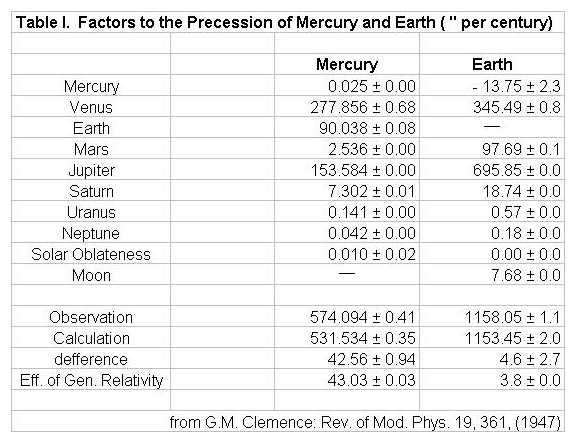
From the data for Earth in the table, the calculated result for its precession differs from the observed value by only 0.4%. Even so, the general relativity was still able to fill in the tiny gap perfectly within the range of error measurement.
If the classical estimates of the precession of other planets also match the observation results such well, it means that this simplified model is basically mature and reliable, rather than, as Professor Wang dismissed in a single sentence, asserting that "the error produced by this overly simplistic model is very likely to exceed 10%".
On the other hand, the same classic model shows an astounding 8% error when only calculating Mercury's precession, it raised a red flag, which warrants serious investigation.
This is why some serious scientists, such as the French astronomer Le Verrier, raised this question earnestly. It was likely also a driving force behind Einstein's research into gravitational theory and his attempt to resolve it.
In the history of physics, there are many examples of theories contradicting observations. For instance, the Rayleigh-Jeans formula in classical thermodynamics, which caused the so-called "ultraviolet catastrophe" of "blackbody radiation," and the Michelson-Morley interference experiment, which refuted the existence of "ether."
It was Lord Kelvin (William Thomson) who likened them to two "clouds" hanging over classical physics at the beginning of the 20th century.
Clearly, imaging what if adhering to Newtonian mechanics were a perfect solution, and all physicists only needed to work to six decimal places, and what if there were no Thomson, Planck, and Einstein, who had the vigilance, concern, and persistent efforts, then the flourishing development of modern physics, including quantum mechanics and relativity, would not have been possible.
Second, regarding the influence of the Sun's oblateness on Mercury's precession, the latest estimates are only 0.0254" per century, not, as Professor Wang exaggeratedly claimed, an overestimation of the "mass distribution within the Sun," which "could easily contribute 1%," or 56 radian-seconds!
Third, besides Mercury's precession, the deflection of distant starlight near the Sun and the gravitational red-shifting of the spectrum are also experimental verifications of general relativity.
In particular, on September 14, 2015, humanity detected gravitational waves from deep space for the first time, experimentally confirming the predictions made in Einstein and Nathan Rosen's 1937 paper, "On Gravitational Waves."
On February 11, 2016, the Laser Interferometer Gravitational-Wave Observatory (LIGO) team in USA announced the first direct detection of gravitational waves at a press conference in Washington, D.C. The detected gravitational waves originated from the merger of two black holes. The two black holes are estimated to have masses of 29 and 36 times that of the Sun, respectively. This marks the first time in history that gravitational waves have been successfully detected directly from Earth.
All these achievements are way beyond the reach of Newtonian mechanics, and certainly not "just a coincidence."
When discussing gravitational waves, we should also mention recent astronomical observations related to binary stars.
The following is a report from Wikipedia.org.
According to general relativity, two masses orbiting each other, such as a binary star system, emit gravitational radiation. The energy lost through this radiation causes their orbits to deviate slightly from the results obtained from geodesic equations. The most famous indirect verification of this problem was the observation of the binary pulsar PSR B1913+16 by Russell Hulse and Joseph Taylor, for which they were awarded the 1993 Nobel Prize in Physics.
The two neutron stars in this binary system are very close to each other and orbit at extremely high speeds, with a measured orbital period of only about 465 minutes. Their orbits are highly elliptical, with an eccentricity of 0.62. According to the predictions of general relativity, such a short orbital period and highly eccentric orbits make this binary system an excellent source of gravitational waves. Energy lost through gravitational radiation causes the orbits to gradually decay, resulting in a shorter orbital period. Through thirty years of experimental observation, even with the most precise measurements, the decrease in orbital period still matches the predictions of general relativity remarkably well. General relativity also predicts that these two stars will eventually collide in about 300 million years.
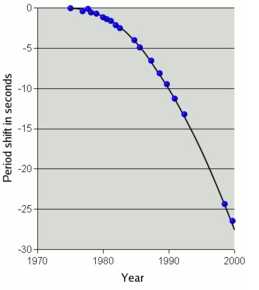
The right figure shows that the experimentally observed orbital period variation of the binary pulsar PSR B1913+16 (blue dots in the figure) perfectly matches the theoretical predictions of general relativity (black curves in the figure).
The binary pulsar system PSR J0737-3039, discovered in 2003, has a periplanet precession of 16.90° per year. Unlike the Hulse-Taylor binary, both neutron stars in this system are pulsars, allowing scientists to observe the two objects with precision. Furthermore, the two neutron stars are very close together, their orbital planes are almost sideways to Earth, and their lateral velocities observed from Earth are very low, making this system the best binary system to date for testing general relativity's predictions regarding strong gravitational fields. Several different relativistic effects have been observed, including orbital decay similar to that in the Hulse-Taylor system. After two and a half years of observation, four independent experiments testing general relativity were possible. The most precise was the Shapiro experiment, which deviated from theoretical predictions by no more than 0.05% (however, the periplanet displacement per orbital period is only about 0.0013% of the circumference, therefore it is not a high-order relativistic experiment).
On April 25, 2013, an international team of astronomers published a paper stating that a massive binary star system consisting of the pulsar PSR J0348+0432 and a white dwarf released energy by emitting gravitational waves. The stars were spiraling towards each other at a rate that decayed to one eight-millionth of a second per year, consistent with the predictions of general relativity. This was the most rigorous test of general relativity to date.
I wonder if Professor Wang Ling-jun has any comments on these new tests of general relativity? In particular, what are his opinions on "gravitational waves"?
Anyway, physics, like a healthy society, she needs "freedom of speech", needs "rights of academic criticism and counter-criticism", and she needs "opposition". At the same time, of course, she also needs constant testing through practice.
After all, "truth is established through debate, and historical facts are cleared from contradictory statements..."
——This is the value of debate.
Written on April 4, 2026.
Relevant Reading:
Jim Shao:"The Three-body Problem" (April 28, 2024)
Jim Shao:"Entropy and State" (October 17, 2023)
Jim Shao:"Langton's Ants" (August, 2017)